Sunday, June 7, 2015

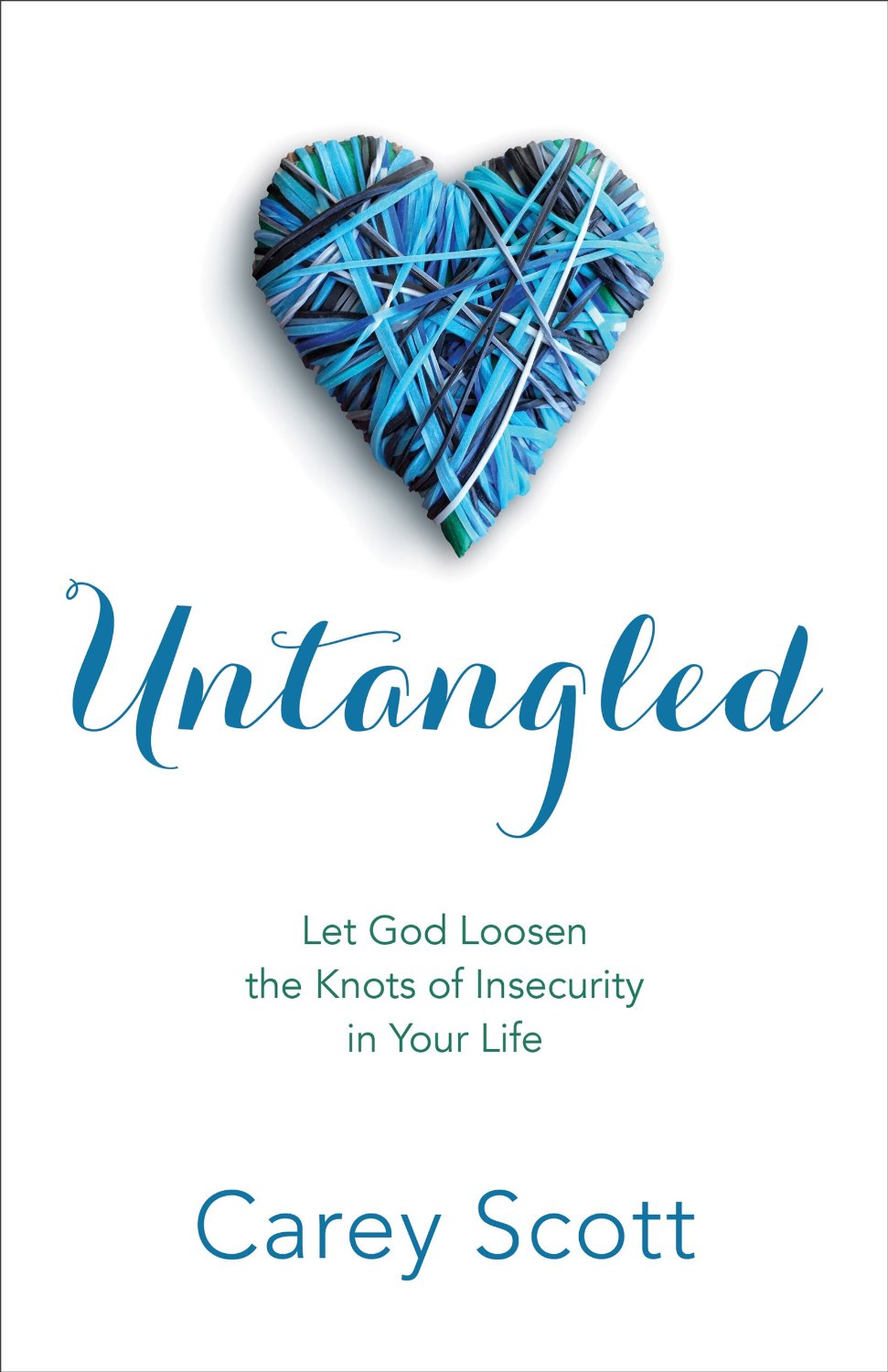
Untangled: Let God Loosen the Knots of Insecurity in Your Life


Wow. I feel like this book was written for me.

From the first pages that Carey Scott pens in her first published venture, "Untangled", her words resonated with me. She introduces you to herself in a very transparent, humble and personal way at the get-go, and the reader is able to see why she could have so many insecurities lingering and fighting to control her soul. In her book, Scott points out the various "knots" that can "tangle" up our lives; from our family and friendships, to our home and the social media, she connects how each of these facets can deceive us, warp our expectations of ourselves and steer us away from our focus on Christ, whispering into our soul that we are "not good enough". She also notes how these insecurities can affect those around us, and the ripple effect that can last for generations when we try to untangle our own knots instead of relying on the Lord to loosen the knots and redeem them in His time. Whether it is our marriage or facebook profile, we can place things on a pedestal in our hearts, and by placing an unhealthy emphasis upon their opinion, turn them into false saviors in our lives. Since only the sovereign Lord is constant and unchanging, this wreaks havoc upon our self-worth.

In each chapter, Scott wittily and whole-heartedly tries to point the reader to the power and validation of worth that is found in Christ alone and how, in His eyes, we are of immeasurable value. Almost every chapter ends with a personal testimony from different women, Scripture verses to anchor us to the Rock, a sample prayer to help break that specific tangle in our lives and questions to reflect. Bible verses are also scattered throughout each chapter, although this was my biggest beef with the book- along with seven other versions, the main "translation" of the Bible used was The Message. I guess I must be old school, and I'm sure it helped make the book flow, but I don't think Scripture needs to be simplified in order to make it personal and relevant. For example, at one point she reflects upon us being the salt of the earth, but the Scripture quoted refers to us merely as a "seasoning". Personally, I feel as though this translation takes away from the depth of meaning that can be found in the Word.

When "Untangled" first came up as a review option to my email, I almost did not request it, because I figured it was another one of those Christian living, self-help books being written today. They are a dime a dozen. I'm so glad I changed my mind. Personally, I think this is one of the best books I've read on this subject. As I read each chapter, my own depravity and helplessness become more and more evident, as well as the necessity for God's grace in every aspect, every moment of my life as I guard my heart against the insecurities that want to rise up within me. Although there is a lot of meat in each chapter, it is a quick read and I highly recommend this book.


Disclosure of Material Connection: To abide by the law of the land, in accordance with the Federal Trade Commission’s 16 CFR, Part 255, I just wanted to let y'all know that I was blessed to receive this book free from Revell in exchange for my review.

Monday, March 30, 2015

Sand in My Sandwich


Sand in My Sandwich is one of those light-hearted, easy reads that makes your time on the treadmill go by fast! It was a perfect follow-up to Holly Gerth's book, as Sarah Parshall Perry candidly and openly lays out her personal and family life for the reader in a witty and inviting memoir-style manner. From her perfectionist-driven legal career, to her whirlwind marriage to a laid-back, country boy husband, and from her three children (two with an autistic spectrum diagnosis) and various pets to her own diagnosis of Behcet's Disorder, she comically relates the good, bad and ugly; through it all however, Perry is always pointing out how God's grace can be seen and His love can be felt through all of life's situations, no matter what they are. With applicable verses to her life's battles scattered throughout, she reveals how even through our greatest cracks, blessings can still overflow from the jars of our lives.


This book is definitely not your normal "how-to" parenting book, but still contained valuable nuggets of wisdom in every chapter; it reminds the reader of God's sovereignty and the need to trust Him in both the big and little things of life. It reminds us that His power and grace are essential in parenting. And it reminds us of His ability to "take the chaos of us and make it something wonderful".


Disclosure of Material Connection: As stated in the review, I received a copy of this book free from the publisher in exchange for the review. I was not required to write a positive review. The opinions I have expressed are my own. I am disclosing this in accordance with the Federal Trade Commission’s 16 CFR, Part 255

Friday, March 27, 2015

You're Loved No Matter What: Freeing Your Heart from the Need to Be Perfect


I knew I would probably enjoy You're Loved No Matter What from the first chapter. After a quick quiz to test whether we feel pressured to be perfect, author and life coach Holly Gerth delves right in on why women give up the grace God so richly holds out to us and strive instead for perfectionism, an expectation many women battle (especially in this age of facebook and pinterest)! She points out that this is exactly what Satan tempted Eve with back in the garden of Eden, and we are still fearfully trying "to be like God" in unhealthy ways. Chapter by chapter, Gerth uses illustrations, analogies and simple, easy to apply advice to stress that we need to focus on the grace God extends, freeing us to live how He created us: focusing on the talents He has given us and where He has currently placed us in life, and not expecting us to be perfect by ourselves or in everything.


Though much of this information wasn't necessarily new, this book was yet another great, practical and Scripture-filled reminder to focus not on the pursuits and viewpoints of this chaotic world, but rather look at our lives the way that the Lord does; to this end, she gently and positively reminds the reader that we are always perfectly loved by a perfect God. It ends with a "Go Deeper Guide" with questions that can be answered individually, with an accountability friend or in small groups. Though it was a quick and easy read, I will definitely be reading through it again to better absorb it's advice and take notes.

Disclosure of Material Connection: As stated in the review, I received a copy of this book free from the publisher in exchange for the review. I was not required to write a positive review. The opinions I have expressed are my own. I am disclosing this in accordance with the Federal Trade Commission’s 16 CFR, Part 255

Monday, November 17, 2014

A Mom's Prayers for Her Son: Praying for Every Part of His Life

As a mother of three young boys, I'm constantly on the lookout for books that give wisdom and direction in raising boys. More so even than these however, I'm constantly looking for guidance on how to pray for them. Prayer is such a powerful tool and weapon at our disposal, and I constantly feel like I lack in this department, which grieves me because I know how effective it is and how it is our best way to communicate and have fellowship with our Lord and Creator. As Rob Tiegen says in the beginning of the book, "Out of all the things my wife does for our family, the greatest are her prayers for us every day. It's a tremendous way that she demonstrates love for her family." I've read other books on being a praying wife and mother, but they have usually all been general in nature, not necessarily giving examples. This one is different.


I loved A Mom's Prayers for Her Son! Written by Rob and Joanna Teigen, the book has a brief preface from each author before diving right in to the meat of it... 77 prayers that cover the needs of your children ranging from discipline and comfort issues, to spiritual maturity and future decisions. The last prayer is even one for when we don't know what to pray! Intermixed between these are encouraging stories from mothers, as well as advice or wisdom when it comes to topics like idols, blessings or failures, where we as parents can become part of the problem. For example, one point that stuck out to me was that we need to be careful in praying for blessings, because when we think we are praying for bread, we might be praying for stones instead, and we don't want the perceived blessings to break their communion with God. Even though I probably wouldn't pray these prayers word for word, they still gave me wonderful ideas so that my prayers don't become monotonous and rote. Each chapter (prayer) also begins with at least a couple of verses (usually in NIV) that pertain to the topic, which I was so thankful for, because if you enjoy praying Scripture over your children, these will give you some direction on where to begin. Although directed towards mothers for their sons, I think many of these prayers could be adapted to meet the need for prayer for siblings, friends, etc, and I have done this already.

I received a copy free in exchange for my review, but unfortunately it was lost in the mail. It must have been divine Providence though, because when the copy arrived, I had been frazzled after a week of dealing with three sick children. I sat down and began reading/praying through some of the prayers and I could just feel the burdens and weariness being lifted and a divine peace settling over me. These prayers were also a timely reminder that no matter how 'great' we are as parents, every good gift is from above, and only God can bring the increase into their lives, giving us a freedom to just be ourselves, if we choose to acknowledge and apply this truth. Although I recommend this book, I think it is best as a reference to go to when you need guidance with what to pray for a specific situation, as it was hard for me to read straight through for the review, even with the scattered personal stories throughout (which I don't think this was made to be a book for that), as many of these prayers are not applicable to my younger children yet!


Disclosure of Material Connection: As stated in the review, I received a copy of this book free from the publisher in exchange for the review. I was not required to write a positive review. The opinions I have expressed are my own. I am disclosing this in accordance with the Federal Trade Commission’s 16 CFR, Part 255

Tuesday, September 2, 2014

Simplify


Simplify. The book showed up on my doorstep as I was surrounded by boxes and junk, packing for our interstate move. Simplify. It sat on our counter amidst the crazy schedule of our last month, the goings and comings, "last" dinners with friends, celebratory meals with coworkers, tearful farewells. Simplify. It travelled with me as I begrudgingly left my children behind and flew to an earthly paradise with my husband who attended conference seminars while I read and explored. Simplify. It lingered on my nightstand through all those first lonely, emotional nights in our new home.
I think this book took me the longest to read of practically any book I've read recently. And it's not because it was not good or applicable. It's because it was. A little too much. From time management to friendships, God gave me this book in His perfect timing to gently whisper to me and constantly remind me of what I need to do: Simplify.
In his book, Bill Hybel focuses upon ten aspects of a person's life, and how we can simplify and declutter these areas, leading to a richer, fulfilled life with our family, coworkers, friends and most importantly, God. By becoming more discriminate with our lives, we are able to better fulfill God's calling for us, rather than sacrificing the intangibles for the non-essentials that will deplete us.  Each chapter ends with "Action Steps" to give you ideas and help you accomplish the chapter's objective. At the end are two appendices dealing with seeking out a life verse (as a supplement to one of the chapters of the book). The book is filled with practical, applicable tips and one-liners that got me thinking...
  • How would I spend my time if I truly believed and lived as if God were in charge of it?
  • Knowing that simple decisions have generational legacies, what investment of my time am I taking with my husband, my children and those I love?
  • Am I living my life in light of this, with the knowledge that I will one day stand before God for the actions taken in this life?
  • Are my excuses really just the surface of underlying character issues that need to be dealt with?
  • Am I living my life as though God's current provision for me is not enough? Am I joyfully living within this provision?
  • Am I so filled with the grace and love of God that I am not easily provoked when the minor irritations of life beset me? Are they first world problems? Am I in need of a reality check? Am I prioritizing people over convenience?
  • Am I fearful and deceived, or am I allowing Christ to reign fully within me, his hand steadying me as I walk on the waters of life?
  • Am I thinking in terms of the years for this present life, or in the immensity of the eternal?
  • What is God wanting to teach me in my current season of life? Is Christ enough for me?


So I read and reread it's chapters. Underlining. Jotting notes and prayers in the margins. Starring sections. Silencing myself from the voices of the world, listening for the whispers of God amidst my tears. No my life still isn't perfect. No, I still have a long way to go before it's bare-bones and only for Jesus. Yes, I've heard some of this information and advice before, but this book helped to keep things in the forefront of my mind. Yes, I will probably mess up again, and need reminders like what this book offers. But I'm on the right course for this race. And for that I'm thankful.


Disclaimer: I received a copy of this book by Tyndale House Publishers in exchange for an honest, personal review.

Saturday, June 14, 2014

I Need Some Help Here!

 
I knew this book was going to be good when I saw the cover of the book and could relate to the picture. With three little ones running around the house, life can be a bit crazy. It's so easy to become overwhelmed, embarrassed or guilty, especially when you compare yourself to others, or your children are not going according to the plans or dreams you had envisioned.

I Need Some Help Here! is a book written by Kathi Lipp. It is filled with not only wisdom and practical advice, but examples and stories from mothers who have weathered and survived the storm of parenthood through the grace of God. I feel like this is a book that I will look back upon often, as it easily relates to young children as well as teenagers. Each chapter points out how the parent can feel desperate, helpless, frustrated or powerless while in the battlefield of life; it then follows with a section highlighting an attribute of God in each of those circumstances. I loved that. It is so easy to forget that He is above all and in all when we are in the trenches. Additionally, many chapters ended with scriptural prayers that can be prayed for both yourself and your child.

This book is for all those moms that need to be reminded that we are not alone, even if it appears that way on the outside. It also serves as an encourager for us to not hold it in, but seek friendships with others that support us, people we can be honest and transparent with, ones that will stand beside us, raising us up and praying for us.

This review was given in exchange for a free copy of the book from the publisher. All opinions are my own. :)

Saturday, June 7, 2014

Finding Spiritual Whitespace

http://www.faithbarista.com/finding-spiritual-whitespace

This post is part of the  “Finding Spiritual Whitespace Blog Tour” which I am a part of...
To learn more, 
CLICK HERE!  
 
We've been a bit non-stop lately.

I once heard the analogy that your life is like a bunch of glass jars lined up on a mantle. Each jar is representative of the time in your day spent with someone or doing an activity. There are only so many jars you can place up there. If you try to put up too many, something else will fall off.

I feel like this is how my life has been these past few months. Some things have unfortunately fallen off the shelf and others aren't getting the time and quality they deserve as I live a jam-packed schedule. And, as, evidenced by the past few posts, my shelf has been sagging, burdened by the weight of it all.

http://www.faithbarista.com/finding-spiritual-whitespace


Enter the need for whitespace. In her book, Finding Spiritual Whitespace, Bonnie Gray explores how we can awaken our soul to spiritual rest and a closer communion with Christ. The Bible clearly portrays God as the divine Creator, the great artist in this world, who formed us all to be beautiful individuals... His handiwork. Gray argues that all great works of art and composition need to be surrounded by whitespace, the place where the eye can rest (or in the case of a composition, a musical interval break). Whitespace quiets the noisy background and gives artistic value. Nurturing our souls with whitespace is a call to actually live a life of extravagance, to recognize that God created us beautiful, as is, and we don't need to clutter up our lives like pictures overtaking a fridge and continue to perform in order to improve ourselves. We need whitespace in order to live a beautiful life for God.

Bonnie Gray was working on her book when she began suffering from anxiety and was diagnosed with PTSD. She began suffering from insomnia and reliving painful memories from her past, ones she thought she had overcome, but had really just been pushed and hidden within her. Through her struggles and search for whitespace, she discovered four elements that are key in this endeavor: creativity, adventure, community and soul care. Gray, the faith barista, writes and provides examples of how you can sip and delight in these elements while nurturing your soul. At the end of each chapter she provides questions and activities for reflection, ideal for a small group setting.

The book was written in an interesting way, skipping from painful memories of Gray's childhood, to more present ones and sessions with her psychiatrist, to reflective application for the here and now. At times it was difficult for me to read, though I wonder if it was mostly from my own burdens at the time. God used this book to speak to me however; almost each chapter I read helped me as I struggled to trust and serve His direction in our move. I was reminded that often, the harder path is to choose rest, looking to none but Jesus. It is not always easy to choose the intimacy rest requires over the safer and easier path of continuing along in my normal routine. It is not a simple flip of a switch, but requires intentional effort to forcefully stop myself to not think of our impending move, but when I did so, it was only then that I felt peace. At my most vulnerable moments was when I could truly feel an intimate relationship with Him, knowing that when I am weak, He alone is glorified. I would definitely like to read this book again, soaking up more of it's applicable wisdom.
 
Bonnie Gray is the writer behind Faith Barista.com who wrote a book about her inspiring, heart-breaking journey to find rest. I was given a free copy in exchange for a review.
If you would like to know more about the freedom and rest  in Christ that whitespace can give you, you can
 get a copy HERE.

Friday, May 9, 2014

Just 18 Summers

I normally shy away from fictional novels. It’s not that I do not like them, but I feel like they are not necessarily a good use of my free time, as I would prefer even my “free” time to be productive in some manner; thus I tend to lean towards books that will lead to spiritual or personal growth. And to be fully honest with you, I also lack self-control. When I start reading a decent fictional work, I get caught up in it so that I can’t focus mentally on the tasks around me until I put the completed book down. Even when the ending is predictable, it’s hard for me to sleep until it is finished… not so bad when I was single, but not when I am married with three little ones running around!

So why did I choose this book to review? I read the description and background behind the book and was interested before I realized it was a novel. But by then my curiosity had gotten the best of me and well, let’s just say I didn’t mind staying on the exercise bike ;)


Written by Rene Gutteridge and Michelle Cox, Just 18 Summers is a novel about four families that struggle with grief, identity and life in the summer after the death of Jenny Browning. From the memories and written accounts in the book (each chapter is written from the perspective of different characters), the reader easily deduces that Jenny was not only a wife, sister, and friend, but also a devout believer in Christ whose life had a left a rippling effect in those around her. Each family is thus left treading water at different stages of life, trying to do it alone, apart from God’s grace. Butch Browning is the father struggling with his new life as a widower. The Andersons are suffering regret as they prepare to “lose” to children to the next stage of life (college and marriage). The O’Reilly’s are a young couple expecting their first child. The Buckleys have fallen into the trap of trying to provide their children every opportunity the mother did not have growing up. 

By the end of the book, through the counseling of a therapist who happens to be a Christian, they’ve all learned the truth that an elderly billionaire learned too late, lonely reminiscing that 

When your child is born, eighteen years seems like they’ll last forever. But it goes by in a blink. … You have just eighteen summers to make memories together. You can’t go back and rewind those days. (p167) 

What a good message though! I’ve found myself thinking “18 summers” often since finishing this book, as it does seem to put it into a more tangible time frame how  much time I have with  my children; it is a good reminder to be intentional with our children, both in teaching them to walk in the Lord and to make lasting memories together, while also not being so fully absorbed in them that you don’t have moments to yourself to get the rest and break you need to rejuvenate yourself physically, emotionally and spiritually.

Although their characters seem to each be a stereotypical extreme, they are nonetheless easily relatable- and I believe most people would be able to identify with one of the four families. Reflecting upon the novel, I was most able to relate to Daphne. No, I didn’t baby proof my home with pool noodles, nor did I worry my floor carpeting was too hard, but I do tend to seek out godly parenting books (you can almost always find one on the nightstand!) in order to try to garner “tangible, applicable” wisdom, when  in conviction I wonder whether if I just read the Bible and prayed whether I would be fairing just as well (if not better), rather than struggling with “not doing enough”, the same thought I think each of these four families struggled with at different degrees. So I appreciated the gentle reminder when Beth tells a laboring Daphne that, “All the books in the world won’t help you live in the moment… God has a plan and a purpose for this little child, and He’s letting you be a part of it, so don’t worry.” (p336) 


What a great reminder of the blessing (and calling) God has given us this Mother’s Day!

Disclosure of Material Connection: I will be received this book free from the publisher in exchange for the review. I was not required to write a positive review. The opinions I have expressed are my own. I am disclosing this in accordance with the Federal Trade Commission’s 16 CFR, Part 255

Friday, April 18, 2014

The Donkey Who Carried a King

With Palm Sunday just past and Easter approaching, I was reminded of The Donkey Who Carried a King, a children's book written by R.C. Sproul, with earthy-toned illustrations by Chuck Groenink. Although it's title could hint towards it being a story about Palm Sunday, the triumphal entry is really only given a page spread in the book, as it's about so much more.

 
Sproul's frame narrative begins with a little boy Reilly walking home from a day playing with friends. He is sad because he was chosen last in their game. His parents direct him to the sage advice of his grandfather who then tells him the story of a donkey named Davey. Davey was a young colt who had yet to be chosen for any task. When he is finally chosen, it is to carry Christ in His triumphal entry through the streets of Jerusalem. After this privilege, Davey sees himself as too important for the trivial assignments given to him by his owner. Through the wise words of an older donkey, Barnabas, as well as later watching Christ walk to his crucifixion, Davey learns the lessons of servanthood, obedience and a joyful heart.
 
As with some of Sproul's other tales, my four-year old wasn't as interested with the story of Reilly so much as he was with the story of Davey. He did have empathy towards Reilly, especially as he recently had been told by another little boy that they were not friends (The beginning of many scars that will happen in his life, I'm sure, but still hard to take in!). He also enjoyed guessing the Bible stories when the donkeys were talking about their famous predecessors. I once again appreciated how Sproul includes in both narratives the involvement of the generations and the father looking to the older grandfather as a source of wisdom (Job 12:12). There were many wonderful nuggets and lessons tucked into the story and expounded upon in a 3-pg discussion portion at the end of the book. The main lesson being that Christ's life was one of servanthood reflected throughout His life and ministry, and is an example to us, His followers (Matthew 20:28).  I loved that Sproul uses the term "master" when the two donkeys speak of their owner. It makes reality hit home more when the older Barnabas instructs, "...whatever the master decides to put on our backs. Every job is important, even carrying a sack of olives, and you should do your best to do it well." The story shows how God chose Jesus for the worst job- taking the sins of mankind with Him upon the cross; with whatever task we have before us, we should perform it diligently with a cheerful heart for the Lord (Colossians 3:23, I Thess 5:16-18). A good lesson when reinforcing the menial tasks around the house (and a good reminder for this Mama when she is often weary from her calling)! This was a good reinforcement for my young child, who is already constantly trying to be a servant and knight. In addition, both the donkey and the boy struggle with identity and purpose, areas where I think many can relate as well. I was able to use this to show my son that we are children of the King and He is our faithful Friend and will never forsake us.
 
In conclusion, our family enjoyed this book and I would recommend it, again, not as a book specifically about Easter week (though the story finishes with Christ's resurrection and the resulting hope for mankind from His shed blood), but as one to help establish biblical character traits. I do enjoy adding it to our books we read during this Easter season however, as it adds a side narrative to the already well-known story and celebration in our home.


Disclosure of Material Connection: I will be receiving this book free from the publisher in exchange for the review. I was not required to write a positive review. The opinions I have expressed are my own. I am disclosing this in accordance with the Federal Trade Commission’s 16 CFR, Part 255

Wednesday, January 22, 2014

Let There Be Light


Archbishop Desmond Tutu, a 1984 Nobel Peace Prize winner, and best-selling author/illustrator Nancy Tillman were teamed together to produce Let There Be Light. With text taken from his Children of God Storybook Bible, this book is written for young children. It elaborately tells the creation story with anthropomorphic detail to make it personal and palpable for the child, including phrases such as, "God's love bubbled over when there was nothing else" and "God... clapped his hands together in delight. 'Isn't it wonderful!'". In addition, Tillman's artwork is imaginative and vivid, with intricate layers such as the wrinkles on the elephant, and the flower bursting forth from an African plain and music sheet.

I thought the illustrations were beautiful and creative. In each picture, Tillman places either the image/form of God or His hand, to show that He was actively involved in the creation of the world, hovering over its existence (although it could be semantically argued that God merely had to speak, no hands needed...). The text only loosely follows Scripture, taking away some of the important repetition seen in Genesis 1 (although Tutu specifies the days, he only mentions the evening and morning differentiations, as well as that God saw it was good once), while embellishing to draw out the feelings in the young child, by reminding the reader of the glory of a flower or how noisy the world would've been after the creation of the animals. Although my two-year old child enjoyed the story, my only real issue with the book is surprisingly what my disappointed four-year old child also pointed out; after I finished, he said that the book was "plain". Asking him to elaborate for me (the illustrations and text seemed anything but!), he said that it wasn't the full creation story, because although God made children, he didn't do it on the sixth day, but instead made Adam and Eve. My child noted that unfortunately, they forgot to draw in these two essential characters to the creation story, with Tillman instead opting for a scene of multi-racial, crowned children enjoying creation.
  
I don't think that our qualm is necessarily a recommendation-killer, but I do think that Let There Be Light  is for those looking for a whimsical book with well-known names attached, whereas those who would rather have the creation account with less embellishment would be best served looking elsewhere.

Disclosure of Material Connection: I received this book free from the publisher through the BookSneeze® book review  program. I was not required to write a positive review. The opinions I have expressed are my own. I am disclosing this in accordance with the Federal Trade Commission’s 16 CFR, Part 255

Monday, January 20, 2014

The Prince's Poison Cup


The Prince's Poison Cup is an allegorical book that begins with a little girl, Ella, who has a stomach ache and is given medicine by her father. Unlike the sugary syrups in today's world, this one did not impress the child and she asked the question, "Why does medicine taste so bad if it's going to make us well?" Her father passes the baton to her grandfather who then tells the child a story about the King of Life who can create anything; He has created a beautiful park for His people and enjoys walking in it with them. He also created a lovely fountain, but gave them strict instructions not to drink it's clear flowing water. Of course they are tempted by his archenemy, and their hearts are turned into stone as a result. They leave the park, set up their own dark city and remain in that state until the Prince enters their city to rescue them. Sent by the King, the Prince must fill a golden cup with murky, smelly poison that bubbles up from their city's fountain. When he drinks it, he dies, amongst a triumphant cold-hearted crowd. The King enters the plaza however, brings Him back to life, and the fountain is transformed. The Prince offers this new water as life to all who would come.

After reading the book once to make sure it was theologically sound, I read it to my four-year old. He loved it and has requested it multiple times the past few days. What did he enjoy about it? First, he liked the fact that there was a king and prince involved. Next, he loved that the story was similar to the redemption story of the Bible. After every page, he would point out that "the King of Life was like God, because He created the whole world too!" or "the archenemy was like Satan who pretended to be that naughty snake and lied". It could be just the boy in him, but he didn't really seem to get into the background story at all, usually zoning out at the end, and I think this book would have been just fine without Ella and her Grandpa. The only thing he said was missing was that the Prince needed a white horse just like Jesus, though I had to remind him that Christ won't come riding on His white horse until the end. :)

I also thoroughly enjoyed reading this book. The illustrations (by Justin Gerard) are lovely and capturing, from the rounded cherubic faces of those filled with love for their Creator, to the hardened, chiseled features of those whose hearts have turned to stone. The author, RC Sproul, is also the founder of Ligonier Ministries. On their website, he states that he started his ministry to "faithfully present the unvarnished truth of Scripture to help people grow in their knowledge of God and His holiness." I believe he accomplished this masterfully in this children's book, as even my four-year old was able to see the allegorical comparison. You can tell Sproul focused on every detail, hinting back to Scripture when he could (There are some great discussion questions and Biblical references at the end of the book). I loved the progression of sin that you could see with the people and the fountain (James 1:14-15, I John 2:15-16), and how he subtly establishes the respect for wisdom from the elderly. Personally, my only fault was at the end, where the Grandpa notes that the origin of sickness was brought about by sin- I felt that his contrasting explanation of this medicine to the cup of poison was forced. In the end however, I highly recommend this book, as yet another creative way (I'm always looking for them!) to teach such the story of God's love, sacrifice and redemption for us.

Disclaimer: I will be receiving a free copy of this book from the publisher in exchange for my unbiased review.

Wednesday, December 18, 2013

Strange Fire


I was looking for a book to read while with the family over the Thanksgiving holiday. Unfortunately, it didn't arrive before I headed out of town, but it has filled up whatever precious little time I've had in between the baking, wrapping, decorating and teaching that inevitably (and at times unfortunately) comes along with the Christmas season. I haphazardly chose the book, desiring a productive, but not thrilling read, which eliminated all the fictional novels that floated about. It ended up still being quite intriguing. The book? Strange Fire.

Yet another work written by John MacArthur, Strange Fire is a book that quite literally unleashes MacArthur's indignation upon the charismatic and Pentecostal communities. Pulling its title from the biblical account of Nadab and Abihu, the son of Aaron, who after being instructed by the Lord about offerings, instead chose to offer "strange fire" and were thus themselves consumed in the fire of the Lord's holy wrath (Leviticus 10:1-3). How does this pertain to the charismatic communities? MacArthur argues that His divine judgment was upon the two brothers because they dishonored the Lord, worshipping Him with contempt, and refusing to treat Him as holy. In like manner, MacArthur declares that the leaders and their flock are dishonoring the Holy Spirit with their ignominious behavior, reprehensible deceit and false teachings.

After giving a few praise testimonials from the general believing public in the beginning (vs praises from fellow well-known authors), MacArthur introduces the subject at hand (easily summarized with his subtitle, The Danger of Offending the Holy Spirit with Counterfeit Worship) and then divides the book into three main parts. Part One focuses on the counterfeit revival, and uses Jonathan Edwards' 5-point "distinguishing marks" from 1 John 4 to validate whether the current charismatic movement is a work of the Holy Spirit. (It should take only one guess to figure out MacArthur's conclusion). The second part focuses on some of their defining doctrines, namely present-day prophets and apostles, tongue speaking, and faith healing. In his third part, MacArthur focuses on the identity of the Holy Spirit, as evidenced in Scripture and discovering what His true work is in the lives of believers. MacArthur ends his book with a letter to continuationist believers (those that believe that the miracles and gifts identified in Acts and I Corinthians did not end with the Biblical apostolic era), "Voices from Church History", and his notes, topical and Scriptural indices.

Although I do not agree with MacArthur on some doctrinal minutiae, I admittedly enjoy reading some of his work, because he consistently includes indepth research on whatever is his focus, copious notes and citations, and an ubiquitous usage of Scripture. In relation to these points, Strange Fire did not disappoint. I was a bit taken aback, though not surprised, by his pointed and accusatory tone towards those within the Charismatic movement. Since I noticed it in a Christian mailing and knew it was out, I did a quick google search and saw that there has been much hoopla over his viewpoints already. My thoughts? Good for him. As Christians, we are called to shed light on areas of darkness and pastors especially are supposed to guard their flocks from ravenous wolves. Is he causing disunity within the body of the church? Perhaps, but I think no more then he does in any of his other works where his beliefs might differ from others within the evangelical world. The only difference with this one versus others I've read, is this book does not hide it's direct accusation from the beginning. Do I agree with him on everything he has written within it's pages? No, but I don't always. I think he tended to lump sum every Pentecostal and charismatic believer as being at fault, though I noticed on at least a couple of occasions he used the non-absolute of "most"... but this could easily be overlooked with page after page of disdain directed towards those within the charismatic world. I for one, know of several believers that consider themselves Pentecostal, and I would not even begin to question their faith as their lives are easily defined by the fruit they bear. But there is a danger of allowing this movement and it's well-known leaders (Hinn, Meyer, Osteen, Dollar, etc) to continue to be associated with evangelical Christianity. I remember in high school, a skit portrayal of Benny Hinn and one of his ill followers desiring healing. I had no idea who Hinn even was, but the skit still produced a hearty laughter from the audience. But to think that the secular society at large might view my beliefs and his as similar and a member of the Trinity as a source for entertainment? Oy vey. Or no wonder people are confused and see us as narrow-minded when outspoken leaders such as Joel Osteen declare that Christ is not the only way to heaven, and justification comes not only through faith, but through your pocketbooks. Que lastima. For that, I'm grateful for MacArthur's bold, albeit controversial book.

In his introduction, MacArthur states that his prayer is that the "Spirit Himself will give you a clear understanding of His true ministry in your own life, that you will embrace a biblical perspective on the Spirit and His gifts, and that you will refuse to be duped by [those which]... vie for our attention today." That was my prayer as I read its pages. And that was the result for me. Would I recommend it? Yes. It is an informational tool for those like me who had no idea the ubiquitious presence of this in the mainstream society today. But I think I would also tell them to in the end, look not on whether someone is "charismatic" or "pentecostal" or any other titular identity, but to test the spirits (1 John 4:1), and look to see if they are bearing the fruit associated with the work of the true Spirit of God (John 15, Galatians 5). We always need to remember to adhere to truth and be diligent to study the Word.


Disclosure of Material Connection: I received this book free from the publisher through the BookSneeze® book review  program. I was not required to write a positive review. The opinions I have expressed are my own. I am disclosing this in accordance with the Federal Trade Commission’s 16 CFR, Part 255

Wednesday, November 20, 2013

Pirates on the Farm


When Pirates on the Farm was offered by my book review program, it immediately caught my attention because my 4-year old loves cowboys, knights and... pirates. The former two are usually virtuous characters and books acclaiming their integrity are abundant. As for pirates? Well, lets just say their favorable traits are few and far between, and books for children that highlight those are rare as well. It seems like most involve and even praise feats of stealing and treasure hunting (which admittedly, is what they were known for). It appears this might be the first in a series (The Next Door Series); they introduce the pirates before the story begins, and there is a glossary of terms at the end.

Written by Denette Fretz, Pirates on the Farm has a very cute storyline. The story is told in the perspective of a farmer's daughter, who has a band of swashbuckling pirates move into the house next door in their southern community. Her younger brother is ecstatic, but her mother is less then pleased. Her father represents the gracious and compassionate neighbor, helping them find their "land legs" whenever he has extra time-- and help they need, from building their pirate ship barn, to shearing sheep. The mother and her brigade of friends almost succeed in forcing them to set sail, but in the end learn the valuable lesson of loving your neighbor and not judging on the outward appearances.

Both my older two children (a four year old and a two year old) loved this story and have requested it to be read frequently. In addition, Gene Barretta did a marvelous job on the illustrations and detail- my son is always pointing out little things here and there on every page. If your child is a pirate fan, I really recommend this book and will be purchasing copies for other little buccaneers I know!

Disclosure of Material Connection: I received this book free from the publisher through the BookSneeze® book review  program. I was not required to write a positive review. The opinions I have expressed are my own. I am disclosing this in accordance with the Federal Trade Commission’s 16 CFR, Part 255